The Challenge: Fragmentation and Inefficiency in School Administration
School management in today’s digital age has become increasingly complex. Administrators are caught in a web of disconnected systems—one platform for admissions, another for fee collection, a separate tool for attendance tracking, and yet another for payroll management. This fragmentation doesn’t just create operational headaches; it fundamentally undermines institutional efficiency and decision-making.
When systems don’t communicate with each other, critical information gets trapped in data silos. A student’s fee payment status exists in one application while their attendance record lives in another, and their exam results sit in a third system entirely. This fragmentation forces staff to spend countless hours manually entering the same data across multiple platforms, creating opportunities for errors and inconsistencies. Teachers spend valuable time on paperwork instead of instruction. Administrators waste hours generating reports that should take minutes. Finance teams struggle with reconciliation. HR staff juggle multiple spreadsheets for payroll calculations.
The result? Operational drag that wastes both time and resources while hindering the school’s ability to make informed decisions.
The Solution: Unified School ERP for Seamless Operations
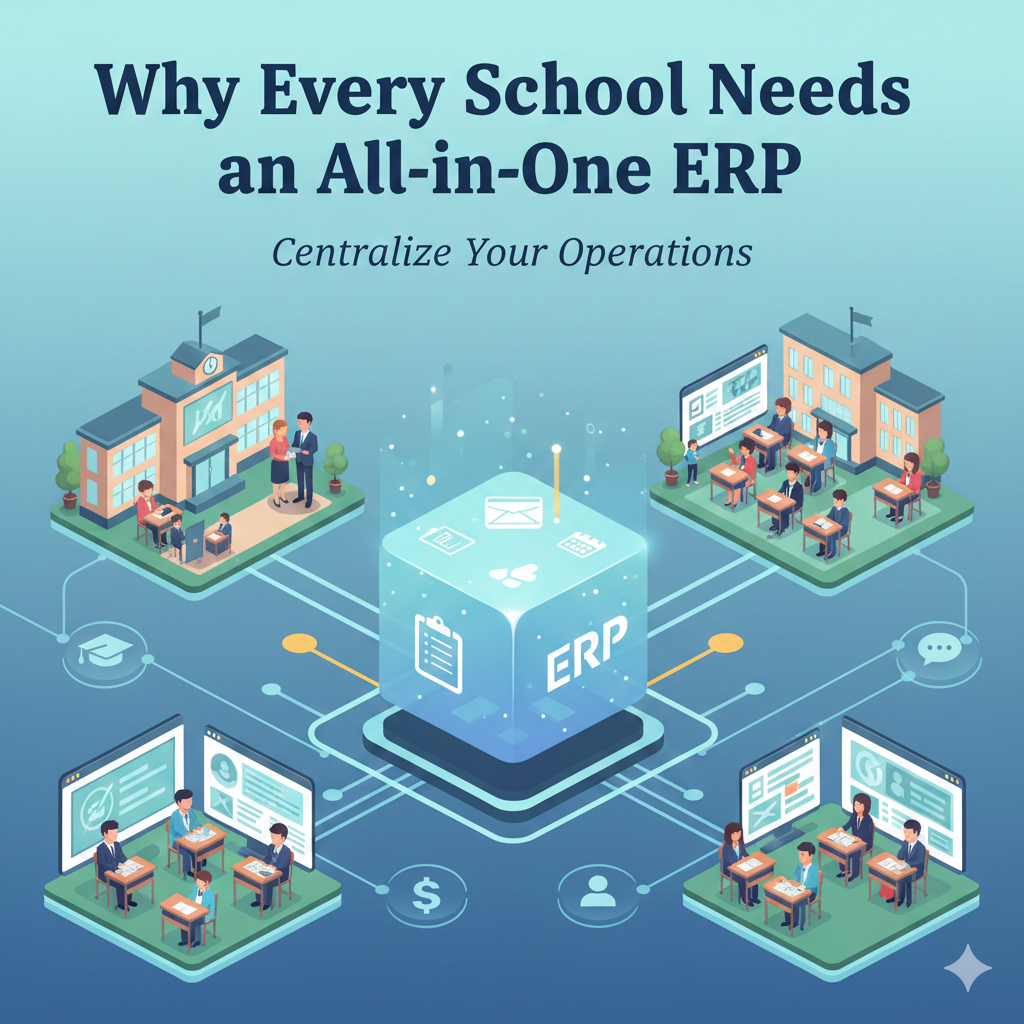
The answer lies in a unified, all-in-one School ERP (Enterprise Resource Planning) system—a single, integrated platform that brings together every critical function of your school on one dashboard. Rather than managing academics, administration, finance, and HR through disconnected systems, an effective School ERP centralizes all operations, creating a cohesive ecosystem where information flows freely and departments collaborate seamlessly.
What Does a Unified School ERP Actually Do?
A comprehensive School ERP system serves as the digital backbone of your institution, integrating five core operational areas:
Academic Management
Student information, attendance records, exam results, grades, and performance metrics all synchronized in one place. Teachers can access real-time student data instantly, while principals gain visibility into academic trends across the entire school.
Administrative Operations
Admissions management, student registration, timetable scheduling, leave management, and document management—all digitized and automated. What once required piles of paperwork now happens with a few clicks.
Financial Management
Fee collection, payment tracking, expense management, receipt generation, and comprehensive financial reporting. Online payment integration means parents can pay fees anytime, anywhere, while administrators have real-time visibility into the school’s financial health.
Human Resources
Employee records, payroll processing, attendance tracking, leave management, and performance reviews. Automated payroll calculations eliminate manual errors and free up HR staff for strategic work.
Communication and Collaboration
: Integrated messaging, SMS alerts, email notifications, parent portals, and mobile applications that keep students, parents, teachers, and administrators connected and informed.
The power of this unified approach lies in the integrated dashboard—a single view that consolidates student information, fee data, attendance, exam results, and employee records. This eliminates data duplication, reduces errors, and provides administrators with immediate access to the insights they need.
Why Fragmentation Costs Schools So Much
Consider the practical impact: when fee data, attendance records, and exam results exist in separate systems, generating a simple report about student progress requires manual data compilation from multiple sources. What should take 15 minutes takes hours. When a student transfers between schools or a staff member changes roles, their information must be manually re-entered into different systems, introducing errors and consuming staff time.
More critically, fragmented systems prevent data-driven decision-making. Without a unified view of data, administrators cannot easily identify patterns in student performance, predict retention risks, or optimize resource allocation. Teachers cannot quickly see which students are falling behind academically while also having attendance issues. Finance teams cannot correlate fee collection patterns with enrollment trends.
An all-in-one ERP eliminates these inefficiencies at their source by ensuring that all critical data lives in one system, accessible to authorized users across departments.
The Efficiency Revolution: How ERP Transforms Daily Operations
The benefits of centralization manifest immediately across every school function:
Attendance and Report Generation
What once required manual tracking and hours of compilation now happens automatically. Digital attendance systems can generate attendance reports instantly, and teachers can spend the time they’d have spent on paperwork on actual instruction or student engagement.
Fee Management and Financial Reporting
Automated fee schedules, payment reminders, and online payment integration streamline collections. Schools eliminate late fees caused by lost payments or manual errors, and administrators have real-time visibility into outstanding balances. Financial reports that previously took days to compile are now generated instantly from the dashboard.
Exam and Grade Management
Instead of manually entering grades into different systems, teachers input them once into the ERP, and the system automatically generates report cards, performance summaries, and trend analyses. Parents can access their child’s grades in real-time through the parent portal, eliminating endless email inquiries.
Admission and Enrollment
Online admission portals allow prospective parents to submit applications, upload documents, and track status without ever visiting the school. Administrators receive applications directly in the system, can evaluate them efficiently, and generate admission letters automatically. What once required weeks of back-and-forth now takes days.
The cumulative impact is profound: automated attendance, report generation, and fee management free up valuable hours that teachers and administrators can redirect toward higher-impact work—actually teaching, mentoring students, strategic planning, and professional development.
Flexibility for Schools of Every Size
One of the greatest misconceptions about ERP systems is that they’re only suitable for large institutions. The truth is far different. Modern School ERPs are designed with scalability as a core feature, making them practical for schools of any size—whether you’re managing 100 students or 10,000 students.
For small schools, an ERP eliminates the need for expensive standalone applications. A school with 100-200 students gets the same core benefits as a large institution: centralized data, automated processes, real-time reporting, and improved communication. As the school grows—adding new campuses, expanding programs, or increasing enrollment—the system scales effortlessly to accommodate greater complexity without requiring system replacement or migration.
For large schools and multi-campus institutions, ERP systems provide the coordination infrastructure necessary to maintain consistency across branches while respecting local autonomy. A school with 5,000-10,000 students across multiple campuses can enforce uniform policies and data standards while allowing individual campus administrators flexibility in implementation.
This flexibility applies not just to school size but to school type. Whether you operate a traditional day school, a residential institution, or a school with multiple streams (CBSE, ICSE, IB), modern ERP platforms offer customizable configurations that adapt to your specific needs rather than forcing your school to conform to the software.
Powering Data-Driven Decision Making
In the era of modern education, data has become the critical resource for institutional improvement. However, data is only valuable if it’s accessible, accurate, and interpreted correctly. This is where ERP systems excel.
A unified ERP dashboard aggregates data from every department and presents it through powerful analytics tools. Instead of struggling to manually compile enrollment trends, fee collection patterns, and academic performance metrics, administrators access comprehensive dashboards that visualize this information in real time.
These insights enable critical decisions:
- Identifying which academic programs are attracting the most enrollment and performing well, allowing resource optimization
- Recognizing student performance patterns early—for instance, noticing that students with low attendance tend to underperform academically, triggering intervention
- Analyzing fee collection data to understand payment patterns and optimize collection timelines
- Monitoring staff performance and resource utilization to identify training needs
- Forecasting enrollment trends and making facilities or hiring decisions based on data rather than intuition
Schools that leverage data-driven decision-making don’t just operate more efficiently—they continuously improve. They identify problems before they escalate, allocate resources to their highest-impact areas, and make strategic decisions grounded in evidence rather than assumption.
Breaking Down Departmental Silos: Enhanced Coordination
Beyond individual efficiency gains, an all-in-one ERP creates something more powerful: institutional coordination. When academics, administration, finance, and HR operate from the same system, they naturally coordinate better.
For example, when a student is flagged for poor attendance by the system, not only can the teacher see this data, but the finance team also receives a notification—because chronically absent students often become fee defaults. Similarly, when new staff members are onboarded through the HR module, their information automatically propagates to the payroll, attendance, and communication systems. When exam schedules are created in the academic module, they’re immediately visible in the timetable, to parents through notifications, and to the transport team for planning.
This systemic coordination reduces the miscommunications and missed handoffs that plague fragmented institutions. Departments work from a single source of truth rather than conflicting spreadsheets and email chains. The principal gains visibility into what’s actually happening across the organization in real time, not days later through compiled reports.
Security, Compliance, and Peace of Mind
A concern that often arises with centralization is security—concentrating all critical data in one system seems risky. In reality, modern School ERPs provide significantly better security than fragmented systems.
Cloud-based ERP systems employ multi-layer encryption, automated backups, access controls, and compliance monitoring that individual schools cannot replicate on their own. Data is protected from loss, unauthorized access, and corruption far more effectively than in spreadsheets and local databases.
Furthermore, centralized systems make compliance easier. Whether managing student privacy requirements (FERPA compliance in many jurisdictions), financial reporting standards, or data protection regulations, ERP systems include built-in compliance features, audit trails, and automated documentation that would be nearly impossible to maintain across multiple systems.
Overcoming the Transition: Getting Started with School ERP
Implementing an all-in-one ERP naturally raises implementation concerns. The good news is that modern ERP vendors have refined implementation processes to minimize disruption. Most systems offer:
- Phased implementation: Rolling out modules gradually rather than all at once, allowing staff to learn and adapt progressively
- Data migration support: Professional teams handle transferring data from legacy systems, ensuring accuracy and completeness
- Training and support: Comprehensive training for administrators, teachers, and staff, with ongoing support to ensure successful adoption
- Customization options: Configuring the system to match your school’s specific processes rather than forcing rigid conformity
While there is an upfront investment in transition, the ongoing operational savings quickly offset this cost. Schools typically report return on investment within 12-18 months through reduced administrative overhead, improved fee collection, and efficiency gains.
The Competitive Advantage of Integration
In today’s educational landscape, schools compete not just on academic quality but on operational excellence and parent experience. Parents expect transparent communication about their child’s progress, seamless online fee payment, and responsive administration. Schools that deliver this experience through integrated systems attract and retain families, while those still operating on disconnected systems fall behind.
An all-in-one ERP isn’t just an operational necessity—it’s a competitive advantage. It positions your school as modern, efficient, and parent-focused. It frees educators to focus on their core mission of teaching. It gives administrators the data and tools to continuously improve institutional performance. It creates the integrated, coordinated environment where students thrive.
The Path Forward
The days of managing schools through disconnected systems and manual processes are ending. The complexity of modern educational institutions—managing hundreds or thousands of students, employees, financial transactions, and communication touchpoints—demands integration and automation.
A unified School ERP system isn’t an optional modernization; it’s the essential infrastructure for educational institutions that want to operate efficiently, make informed decisions, and deliver exceptional experiences to students and families. By centralizing academics, administration, finance, and HR on one platform, schools eliminate data silos, dramatically improve coordination across departments, and free valuable human resources for higher-impact work.
For schools seeking the best ERP for Indian schools that offers true centralized school operations, the path is clear: invest in an all-in-one ERP system specifically designed for educational institutions. The efficiency gains, data-driven decision-making capabilities, and operational coordination benefits are too significant to ignore in today’s competitive educational environment.